This video? Same agent.
The Lab needed a 44-second reel that says what it is and why it exists. An agent made all of it: the script, the music, every diagram and title, the recordings of the site, three cinematic shots, the edit on the beat, and the checks before anyone saw it. I approved and gave notes; I never touched a timeline. This entry is how that works, what eleven rounds of review taught, and a playbook with the skill that lets your agent do the same. The whole reel cost $12.78 in generation.
A 44-second reel that says what The Lab is, why it exists, and what a visitor gets from it.
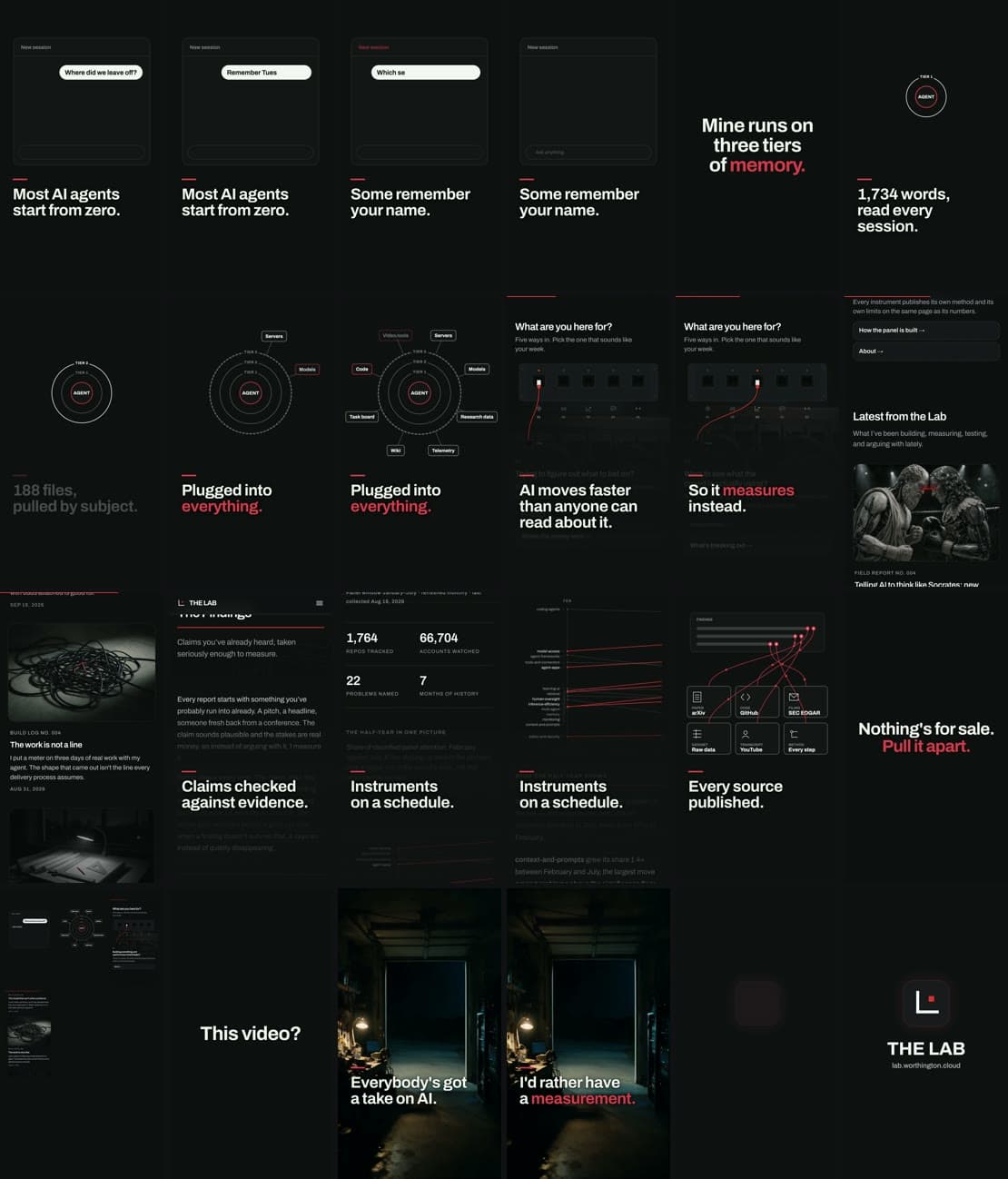
It opens on an agent that forgets, turns to one that doesn't, shows what that memory is plugged into, and then says why The Lab exists: AI moves faster than anyone can read about it, so it measures instead. The pages under those words are the real site, recorded.
The agent does the whole job, or the reel's best line is a lie.
Near the end the music keeps driving and the screen says This video? Same agent. That line is only true if the agent makes everything, so that was the rule from the first question. It wrote the script, made the music, drew the diagrams and titles, recorded the site, prompted the three cinematic shots, cut all of it, and checked the result. I answered questions, picked between options, approved each paid step, and gave notes. I never opened a video editor. If I had, the line would have come out.
The agent is the editor. The human is the client.
About three and a half hours of sessions over an evening and the next morning.
The thread
Six habits made this work. None of them is a special tool. Each one is a way of keeping an agent's work honest and cheap while it does something it was never really built for.
Five questions, one at a time, each with the agent's recommended answer, every answer saved to a file.
Before a cent was spent, the agent ran a short interview on the taste calls: do I appear in it (no, not even my name), what the music should feel like, what picture carries the memory beat, what the last line is, and whether to keep the Same agent twist. Each question came with its own suggested answer, so most took one word to settle. Each answer went into a notes file before the next question, so nothing lived only in the chat.
The method is borrowed from Nate Herk's grill-me skill[1]. Then the agent pitched the story as a
beat sheet, and later, when the story needed rebuilding, as three competing beat sheets with a
recommendation. It waited for a pick both times.
Video models garble text, so no word, label, diagram or logo in the reel came from one.
Every title, the chat window that keeps forgetting, the memory diagram, the sources scene and the end card are drawn by code: a small web page paints each frame for a given moment in time, and a headless browser saves thirty of those frames a second. The same scene renders identically every time, every label is sharp, and changing a word costs nothing. That is why the notes after version four were free.
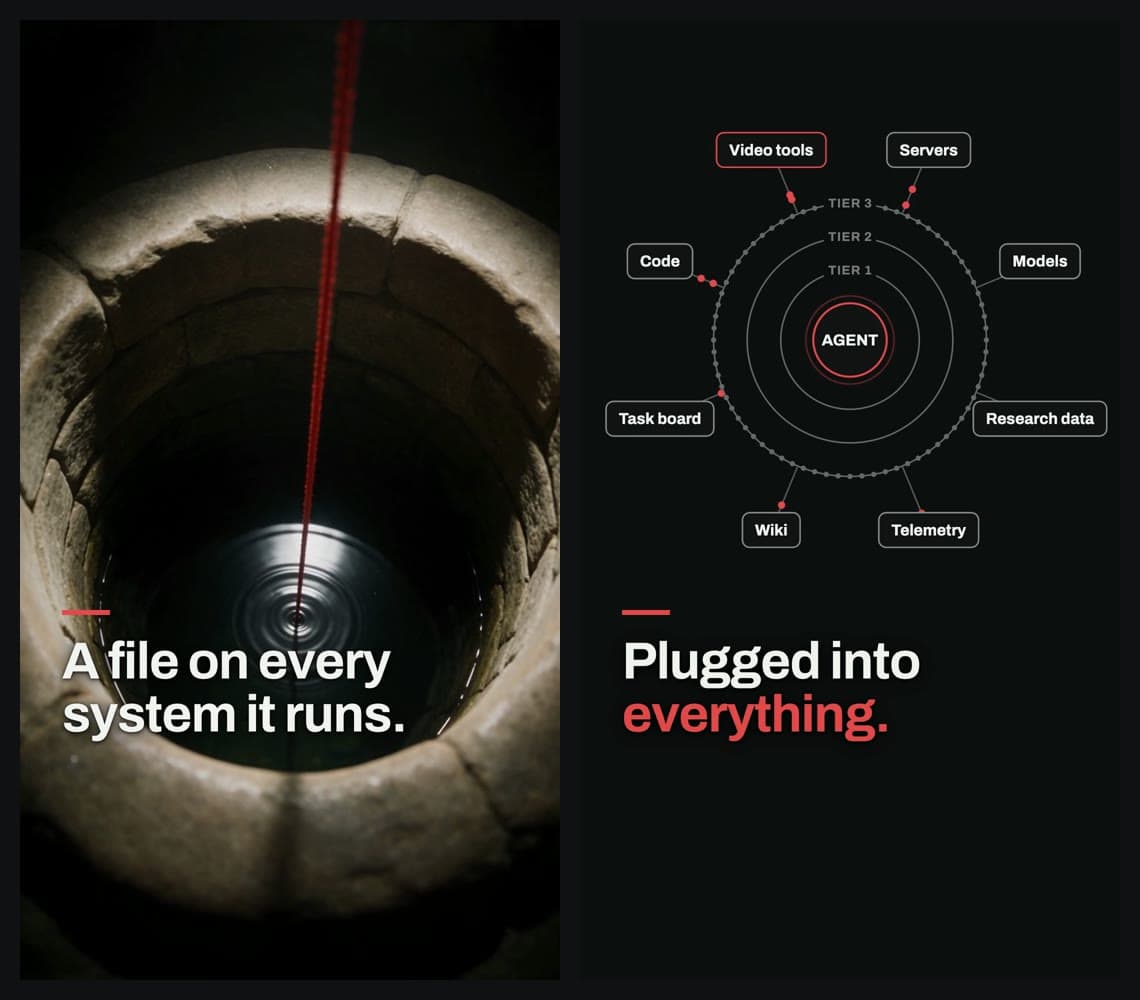
The pages in the reel are recordings of the live site, not mockups.
The agent scrolled real pages in a headless browser at phone size, one exact scroll position per frame, so the motion is perfectly smooth and a re-recording gives the same shot. Every number on screen was re-checked against its live page on the day the reel was rendered. Real material is the whole argument of the site, and it costs nothing.
Three short cinematic shots and one music track. Everything else was free.
The paid work went to two services. Music came from Suno, reached through kie.ai[2]: 12 credits for two 45-second instrumental takes. Four rounds made eight takes; the first direction, dark electronic, was "too ominous," and the pick was a hip-hop and electronic hybrid. The shots came from Seedance 2.5 on Higgsfield[3], turning a still image into five seconds of motion: a lamp flickering on in a garage, a slow push toward the open door.
Each shot was drafted at 480p for about $1.03, checked frame by frame, and only then rendered at 720p for about $2.31. On a phone, 720p and 1080p look nearly the same, and 720p costs less than half as much. The opening shot's draft ignored its prompt: asked for a sine wave, it drew a flat line. That flatline said "starts from zero" better than the prompt did, so it was kept, until a later story no longer needed it.
The agent measured the track's beat grid, and the whole edit is built on it.
Take 7 runs at about 95 beats a minute, so one beat lasts 0.628 seconds, and its first big hit lands at 7.61 seconds. The opening runs exactly until that hit. After it, every segment is a whole number of beats long, so every cut lands on a drum. The edit is one table in one script: each row names a segment, its length in beats, what's on screen, and which words sit on top. Change a row, rebuild, and the whole reel stays in time.
The music plays straight through at full volume and fades at the end. An early cut dropped to silence for the twist and then restarted the track; to a viewer that sounded like a broken file. A softer dip didn't work either. Drama comes from the picture now.
Before I saw a cut, the agent had already looked at it.
Every generated clip was pulled apart into frames and inspected for warping, melted objects and invented text before it was shown to me, a habit taken from Nate Herk's walkthrough of the same tools[4]. Every cut got a contact sheet, a look at its first frame, and a brightness measurement of each segment. Every generation got a row in a cost ledger, kept or rejected, with the reason.
The thread
The first full cut, version two, followed the script and still needed ten more. Each note below is mine, in plain words; each fix is the agent's. Most cost nothing.
Twelve versions, from a cut that followed the script to one a stranger understands.
- 2The audio drops out at 28 seconds, then starts over.
It was designed that way: silence for the twist, then the drop again. A viewer hears a broken file. v3 tried a muffled dip, which didn't work either. v4 plays the track straight through. Approved.
- 5Two people who had never seen it didn't get the well, the keys, or the logo.
I showed v4 to two family members and watched them. The metaphor shots didn't translate, a shot of cables was boring, and the logo beside the words read as a letter: "L The Lab?" v5 drew the real things instead: a chat that forgets, the memory diagram, and the logo above the name.
- 6The sources background is meh, and the grid is missing a tile.
A new drawn scene wires a claim to six source cards. The tile grid's ninth tile was due on the scene's last frame and never appeared; they now land faster and all nine hold.
- 8"155 days" and "The models." don't say anything.
A number that will be stale the day after posting, and a label the picture already carries. Cut. v9 cut "The data." for the same reason.
- 11Make it clear the logo is a logo.
The mark now sits inside its own rounded app-icon tile and draws itself like a chart, the upright first, then the baseline, then the red point on the beat. Nobody reads a chart as a letter.
- 12"What's this reel for?"
The big one. The reel bragged about an agent, then showed a website, and never said why the website exists. "Every AI chat starts from zero" was also no longer true. The agent pitched three new stories; the pick connects the agent to why The Lab exists and what a visitor gets. Then four smaller notes: the homepage headline gave away the closing line early, the first frame was an empty box, "chats" should be "agents," and some blacks were gray.
Two notes turned out to be about something other than what they seemed. The grays were real: pieces saved on two different brightness scales lift black to gray when they're joined, and the agent measured it (11 on one segment, 26 on the next) before fixing it. The circles that looked taller than wide were not: measured, they were exactly round. Labels wider than the rings were notching them. Shorter labels fixed it.
The agent can check every frame. It can't tell you what a stranger thinks.
Every mechanical check passed on version four. What found the real problems was watching two people see it cold. After that, every cut shipped with the same reminder: show it to someone who has never seen it, and ask one question. What's this for?
What cost money and what didn't
Every paid generation for the vertical cut happened before version five. Every note from version five on, including the new story, was fixed in code for nothing. The widescreen cut needed one new shot, for $2.31, because a vertical clip can't be cropped wide without losing the lamp.
The thread
Everything above is packaged as a skill: a set of instructions and scripts an agent loads when you ask for a reel. It starts where this reel finished, with the notes already applied.
One prompt installs it. It's free, open source, and yours to change.
The skill lives at github.com/WorthingtonCloud/sizzle-reel under the MIT license. It works with Claude Code, or any agent that can run commands on your computer and keeps a folder of skills. Paste this to your agent:
Install the sizzle-reel skill from https://github.com/WorthingtonCloud/sizzle-reel. Clone the repo and copy its sizzle-reel/ folder into my skills folder (for Claude Code: ~/.claude/skills/sizzle-reel). Then read its SKILL.md, set up a reel folder from its kit, run node doctor.mjs, and tell me what's missing. When everything passes, interview me for my first reel.
It needs Node, Python with numpy, and ffmpeg on your computer; the doctor script checks all three and says how to fix what's missing. Paid shots and music need a kie.ai key and, for video clips, a Higgsfield key. A reel built only from drawn scenes, recordings of your own pages, and your own footage needs neither.
What you do, and what you should see at each step.
- 1Answer the interview.
About eight questions, one at a time, each with a suggested answer: what the reel is for and where it will post, what a stranger should get from it, the one line they should remember, what real pages or footage you have, the music, whether you appear, the budget, and who you'll test it on. You'll see a notes file fill up as you go.
- 2Pick a story.
The agent pitches two or three beat sheets, with what each costs, and recommends one. Nothing is built until you pick.
- 3Approve the $2 test, and pick the music by ear.
Two music takes for about 6 cents and one cheap draft shot. Your ears decide; the agent can measure loudness but can't hear taste. Ask for another pair in a different direction if the first misses.
- 4Wait for version one.
The agent draws the scenes, records your pages, finds the beat grid, drafts the paid shots, and cuts it. It checks the result before you see it and tells you what it cost so far.
- 5Give notes in plain words.
"This part is boring." "That word is wrong." "The logo looks like a letter." Most notes cost nothing. The agent names the cost of any that don't before doing them, and every version gets a new number.
- 6Show it to someone cold.
Someone who has never seen it. Watch their face, then ask what it's for. If their answer isn't yours, that's the next note.
- 7Post it with its cover.
The hook is on screen from the first frame, which is what chat apps show before anyone presses play. Where the platform lets you pick a cover image, upload the one the build made.
Between nothing and about $15, and you approve every dollar first.
The paid script refuses to spend without an explicit yes, and refuses to go past the budget you set. Every generation is logged, kept or rejected, so the total is always one command away.
Each one below was a round of notes on this reel. The skill applies them from the start.
- 1Never let a video model draw words.Titles, labels, logos and diagrams are drawn in code. Paid shots are textless mood only.
- 2Show the real thing, not a metaphor.A stranger decodes a diagram of the actual system faster than any symbol for it.
- 3Never stop the music.One track, full volume, fade at the end. Silence reads as a broken file.
- 4The first frame is the preview.Put the hook on screen from frame one.
- 5Spend the closing line once.Don't show a page whose headline is your closing line before the close.
- 6Cut anything that dates itself or says nothing.Let the picture carry it.
- 7Fill every grid, and match every black.A hole or a gray patch looks like a mistake, because it is one.
- 8Put the logo in a tile, above the name.Beside the name, a simple mark reads as a letter.
Costs come from the agent's ledger; the video costs are estimates.
Every generation was logged as it happened, with the service, model, resolution, length, cost, and whether it was kept. kie.ai reports credits, so the music and still costs ($0.45 together) are measured. Higgsfield has no spend report through its API, so the video costs ($12.33 together) are estimated from its published token pricing: height × width × seconds × 24 ÷ 1,024 tokens at $0.0214 per thousand. The billing page is the source of truth. The beat grid (0.628 seconds, first hit at 7.61) was measured from the track and confirmed by ear. The black-level figures (11 and 26 on a 0–255 scale) were measured on a flat patch of each segment. The session time is from the conversation timestamps.
One reel, one taste, two cold viewers.
This is one reel, made for one site, judged by one person's taste and two people's reactions. The skill packages what this build learned; it has not yet been used by a stranger on a different subject, and the first person who does will find a note this reel never needed. Seedance and Suno change often, and their prices and behavior will drift from the figures here. The agent's session time does not count the time I spent watching cuts and thinking about notes.
Sources
- ExtNate Herk,
grill-me, a Claude skill: interview one question at a time with a recommended answer each, and write every answer to a file before asking the next. The interview-first rule and the preflight check in the skill also follow his scroll-craft (MIT). - Extkie.ai's Suno API: model V6, instrumental, custom mode; 12 credits per call returning two tracks. Stills from Seedream 5 Pro on the same service.
- ExtHiggsfield API, ByteDance Seedance 2.5 image-to-video: 5-second clips at 480p and 720p, priced by the token formula above.
- ExtNate Herk, video walkthrough connecting Claude to Higgsfield: the agent inspects frames from every generated clip before the human sees it, and keeps a running cost log.
- DataThe reel's build: segment table, drawn scenes, recordings, titles and ledger, retained. The public skill and its kit: github.com/WorthingtonCloud/sizzle-reel.