
Trying to figure out what to bet on?
Somebody is selling you a picture of what AI does. I check it against the evidence.
Measuring AI. Instruments running.
This is a workshop for AI and agents, with the garage door open.
Read the recordAI moves faster than anybody can read about it, so I build the thing, point instruments at it, and write down what actually happened.
Then I put the whole mess out here, because somebody arguing with me is worth more than another take that agrees.
I build things, I point instruments at the field to see what’s actually happening, and I write down what I find. The wrong turns go in too.

Nothing here is for sale. No newsletter funnel, no consulting pitch, no product hiding behind the curtain.
You’re the part I can’t do alone. Every source and every method is published so you can pull the work apart. Tell me what I missed, or where the framing is off.
Five ways in. Pick the one that sounds like your week.
Somebody is selling you a picture of what AI does. I check it against the evidence.
Theory is cheap. I’d rather build the thing and tell you what it cost and what broke.
Not what a vendor announced. What developers put real hours into, measured on a schedule.
Nobody has time for a thirty-minute report on a Tuesday. There’s an assistant on every page that has read all of it.
Every instrument publishes its own method and its own limits on the same page as its numbers.
What I’ve been building, measuring, testing, and arguing with lately.
An agent scripted, scored, drew, recorded, cut and checked a 58-second reel by itself. Here is how, and the skill to make your own.
Does telling an AI to think like Socrates make it smarter? On 15 real bugs it changed the voice and the bill, not the answers.

Most companies handed out AI and got faster email. The payoff comes from changing how work moves between people.
A free model on a Mac mini takes the first look at every request and passes only its doubts up. When does that cascade actually pay?
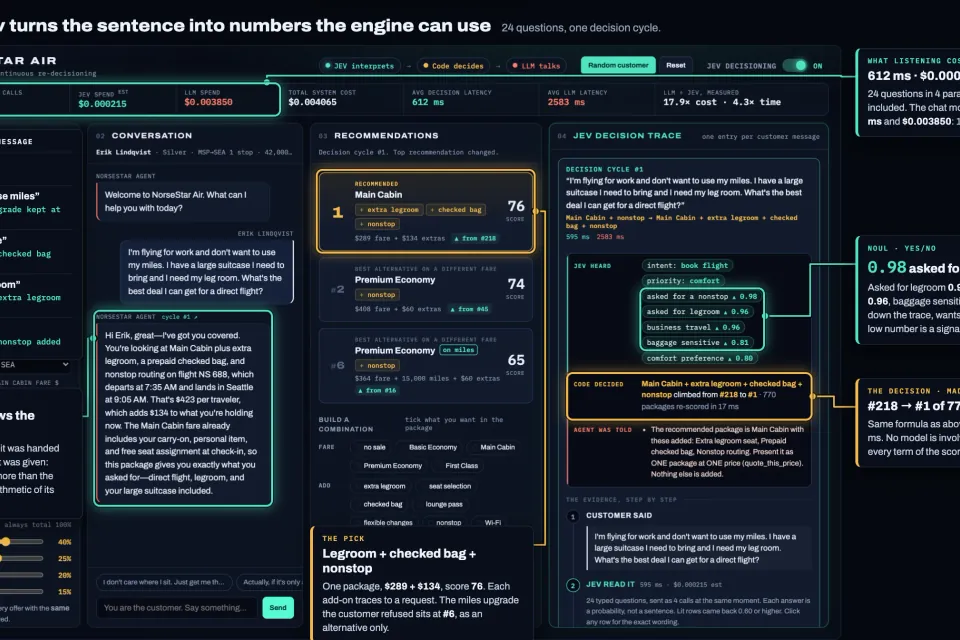
It can't write a sentence, and it was adopted faster than any model before it. What a typed yes-or-no with odds attached is good for.
I put a meter on three days of real work with my agent. The shape that came out isn't the line every delivery process assumes.

A project written up before it's built, then held up against this site's own findings. Four of my habits survive. Four don't.

The picture being sold to boardrooms is roughly right. Almost everything expensive about how it's being bought is not.
Everything else, in the order it happened.
What is this site, in one line?
A homelab for AI and agent work, open to visitors. Rick builds things, points instruments at the field, and publishes what happened, wrong turns included.
How far can I trust the numbers?
Each instrument publishes what it counts, what it misses, and every reason to trust its numbers less than a census, on the same page as the figures. Start there.
Where do I start if I’m short on time?
Findings. Each one is a claim tested against the evidence and graded before it goes up. Pick the one closest to your week.
Checking the answer against the site
It answers from the published pages and says so when they do not cover something.